Tag: balance

Clean eating? Healthy eating? What about nutritious eating?

hampstead heath

There’s been a lot of chatter in the media this week about the end of ‘clean eating’, with many disavowing this term, saying that it has led to a rise in disordered eating and anorexia.

The denouement of the majority of these pieces tend to call for moderation and for more healthy eating.

I will always applaud anything that helps people get to grips with what and how they eat.

BUT.

It seems to me as health professionals, that we’re suffering from terrible reductionism when it comes to advocating for better quality eating. On one side, there are those that are demonising whole food groups  (i.e. ‘all wheat/sugar/dairy/etc/etc is bad’) and the other side, proclaiming the answer is to simply eat a healthy, balanced diet. Both extremes are very reductionist and don’t offer the nuance that people need. But nuance doesn’t sell newspapers / magazines / books, doesn’t it?

What if you don’t know what eating healthy actually is and what it means for you? What if you’ve picked up the first Deliciously Ella book because everyone was talking about it and you thought it might teach you a few healthy eating tips and tricks? Are you now a part of the clean eating brigade (how I hate that term)?

I’ve discussed this topic before on the blog. The rise of the concept of clean eating isn’t a bad thing. Becoming more aware of what you put into and onto your body is good – we could all benefit from mindfulness when it comes to the way we eat. And with everything, there will always be individuals who have no brakes and take advice and concepts to their limit.

Equally, there will always be charlatans who peddle bad advice. Rather than blame the clean eating bloggers and instagrammers, surely asking people to take some agency around what they put into their bodies isn’t a big ask? Just as we ask people to educate themselves in other areas of their lives (finance is an area that comes to mind), it is not outrageous to expect people to give themselves a broad education into the benefits and drawbacks of the food they feed themselves and their families and to look at what they see on TV and in newspapers and magazines with a critical eye.

I firmly believe that we need to start thinking about food in terms of how nutritious it is. ‘Healthy’ is such a empty, almost meaningless term. Nutritious – the vitamins, minerals, protein, carbohydrates, fats in food – is more meaningful and has tangibles that can be referenced.

And what about flavour? Nutritious and flavourful aren’t mutually exclusive. Just as there’s pleasure in eating rich, indulgent foods, there’s also a lot of pleasure in eating nutritious, flavourful foods. The pleasure of eating these foods should ideally last from the moment of anticipation when you first put it in your mouth through to the lovely feeling of satiety when you’ve finished the meal.

Oh, one last thing. Get rid of the guilt. Enjoy the food you do eat and find pleasure in the making and eating of nutritious, flavourful meals.

Have you tried seed cycling?

sunflower

I first heard about seed cycling a couple years ago on a natural health podcast and found it very intriguing.

The basic principle of seed cycling is that it is possible to use the primary micronutrients in a few seeds to help balance female sex hormones.

Infertility, dysmenorrhea, amenorrhea, PMS, acne, fatigue and other problems that have links with the menstrual cycle and female sex hormones are becoming more common.  Some of this is due to lifestyle and diet choices, which for some women can cause sub-clinical deficiencies in zinc, selenium and B vitamins –  some of the key micronutrients that help build female sex hormones.  Adding these micronutrients back in systematically can help restore balance.

What are the female sex hormones and why are they important?

If you think back to your biology classes in high school, there are four phases to a woman’s monthly reproductive cycle. At each phase in her cycle, a woman’s body produces different hormones to support the different activities that are happening in her uterus and ovaries.

  1. Menstrual phase: Follicle Stimulating Hormone
  2. Pre-ovulatory phase: Estrogen, Testosterone and Luteinising Hormone
  3. Ovulation: Luteining Hormone
  4. Post-ovulatory phase: Progesterone, Estrogen

Good, balanced hormone production is important not only for regular menstrual cycles, but only for stress management. Too much estrogen (known as estrogen dominance) and too little estrogen can both be problematic in their own way.

Some doctors will prescribe the oral contraceptive hormone as a means of hormone balancing. Before going down that route, there are some natural methods, like seed cycling, to consider.

seed cycling to support hormone balance

The nitty gritty of seed cycling

You’ll be using flax, pumpkin, sunflower and sesame seeds, all of which have different micronutrients that support hormone production at different phases of the menstrual cycle.

Flaxseeds and sesame seeds: Both seeds contain lignans, a polyphenol phytonutrient which can block excess estrogen production in the body.

Pumpkin seeds: The zinc in this seed supports progesterone release, which is important for having normal, low pain periods. Zinc also ensures that excess estrogen doesn’t convert to testosterone, which can be very problematic, particularly in PCOS sufferers.

Sunflower seeds: The selenium in this seed supports phase 1 liver detoxification (where your liver begins to clear excess estrogen from the body).  Selenium also helps produce glutathione peroxidase, a very powerful antioxidant.

How to do it

This can take between 1 and 4 cycles to see an effect, so bear with it. If your cycle is longer or shorter than 28 days, just start the second phase the day you ovulate. Day 1 starts the first day of your period. If you aren’t tracking your cycles already with an app or notebook, I strongly urge you to do so. It’s interesting to look back and see how different events can affect the length and strength of your cycle.

Day 1 – 14 (follicular phase): 1 tbsp flax seeds, 1 tbsp pumpkin seeds – these seeds help your liver clear the extra estrogen that can occur during this time of your cycle and the zinc in pumpkin seeds prevent excess testosterone production.

Day 15 – 28 (luteal phase): 1 tbsp sunflower seeds, 1 tbsp sesame seeds – these seeds are rich in zinc and selenium which help progesterone production during this phase of your cycle. They are also high in essential fatty acids, which help balance progesterone and estrogen and support the cell membrane (outer layer) of your eggs.

Take the seeds in the morning if possible, try to get organic seeds and with the flax, try to grind them fresh because the oils in the seeds can go rancid if they’re ground and kept out for too long.

There are so many different ways to have the seeds in the morning.

  • Add them to a morning smoothie
  • Mix them up with some organic full fat Greek yoghurt
  • Make an omelette and then sprinkle them over the top
  • Mix them into a morning salad
  • Date balls! Try this recipe and add in the relevant seeds for the respective time in your cycle
  • Or simply take them with some water

Have you tried seed cycling? Did it work for you?

Photo by Unsplash

How do you stay healthy when you drive everywhere?

62 miles to London

We’ve just spent a lovely three days in Rye, a small, whimsical city on the South Coast of England. We drove down from London for some sorely needed time to recharge our batteries and enjoy some family time in the dog days of summer.

It was nice to get out of London for a bit, explore a new area and be reminded that there is life outside the Big Smoke.

Having a car for our mini break gave me a different vision of what life might be like. We don’t have a car, so we walk or take public transport everywhere we need to get to in London.

There are positives, like the sheer convenience and ease of getting from one place to another.

And there are a lot of negatives. The environmental cost is a big one. Another big negative is the lack of exercise. When I compare my step count (yes, I do check this quite often in the Health app on my iPhone) for the last three days to the same time last week, the difference is breathtaking.  I try to get at least 10,000 steps / 5km a day – it’s arbitrary, but it works for me.

With a car, I’ve missed the latent exercise I seem to regularly fit in, from running for the bus, standing on the tube and walking up the stairs at work.

If you drive regularly, how do you fit in exercise? Is it something you have to schedule into your diary as a can’t miss appointment? A car might be in our future, as our lives get busier and I’m keen to make sure it doesn’t have a detrimental effect on our health.

End of (school) year reflections.

reflections

I’ve reached the end of my second year of my nutrition studies and I’ve had a few weeks to pause and take stock of the past year.

It’s been a really full on time, between working, studying, being a mother and wife and having a semblance of a social life. I’ve been juggling quite a few balls (and have dropped a few), but I’ve found an (im)balance that’s worked for me.

After two years of nutrition study, I’m even more sure that I’ve found ‘my calling’. That sounds corny, doesn’t it? But it’s so true.

I’ve found the lectures fascinating, learning about everything from phytonutrients to energy metabolism to supplements. And the practical element has been even better, seeing in clinic how proper nutrition and supplementation can have such a powerful effect on clients. It’s hard work, but I love it and am so excited to dive into a field that’s changing so much. To think that just ten years ago, we didn’t know much about the gut microbiome – what will we discover in the next ten years?

So what’s next?

Next year, we go deeper into specific topics such as nutrigenomics, women’s health, detoxification organs and support methods, amongst others. And we get closer to clients in clinic, with the expectation that by the end of the year, we’ll be able to run a clinic ourselves and give clients relevant, tailored and practical recommendations.

And I work out what I want to specialise in. Right now, I’m leaning towards women’s health, with a focus on pre and post natal mothers, as well as working with women who’ve suffered from miscarriages. This is such a rich area, where certainly in London, women don’t get the support they need and deserve.

Here’s to a great summer and a new school year with lots of growth and learning!

Photo by Paul Gilmore

Things I Love: 13 Ways To Simplify Your Life

I recently had the pleasure of attending a talk with Sarah Wilson, the Australian journalist who has spearheaded the I Quit Sugar movement in Australia. She spoke for an hour about 13 ways to simplify your life. It was a really fun talk with loads of brilliant examples and tips. And I got my copy of Simplicious signed!


Here are her tips one by one – enjoy!

1. Stop Eating (So Much) Sugar

This is a no brainer. Sugary food has moved from being a treat that you might have at the weekend, to a must have after every meal. One of the ladies in the audience shared the problem of her son’s nursery offering a sugary dessert after every meal and asked for Sarah’s advice on what to do. My son’s nursery does the same and it drives me nuts. Food habits start early and I definitely don’t want J to be in the habit of expecting something sweet after each meal. Sarah advised the lady in the audience to have an honest chat with her son’s nursery – my experience is that nurseries think it’s normal to give a pudding after every meal so I just ask J’s nursery not to give him any sweet puddings all, that way when he has ice cream or cake with us or at a party, it actually is a treat. Problem solved.

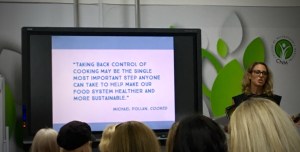
 2. Cook

sarah wilson michael pollen quote

It seems so simple, doesn’t it? Sometimes the very act of cooking with fresh, local and organic ingredients seems almost revolutionary.

3. Ride a Bike and 4. Walk

They’re both cheap, easy and give you the benefit of exercise and the opportunity to take in your surroundings in a different way.  As a Londoner, it’s hard not to walk, whether it’s to and from the tube, doing the nursery pick-up and drop-off  or meandering around the neighbourhood. Sarah raved about Boris bikes and I made a mental note to use them a bit more often – they’re so easy and fun!

5. Slow Cook

I love my slow cooker. It is such a brilliant way to cook, especially knowing that after a long day at work in the winter, you have a warm meal waiting for you. Slow and low, Sarah advised, is the best way to cook. It better preserves micronutrients and phytonutrients and the long cooking time generally means that the food is more flavourful.

 6. Use Less Stuff

Sarah showed an amazing photo of her wearing a ‘Consume Less’ t-shirt when she was explaining this point. She urged us to reuse everything (something she does brilliantly in her latest book, Simplicious), to simplify our wardrobes and to generally not be so bound by the stuff that surrounds us. We’re currently on the cusp of a house move and I can really relate to this point as we’ve prepared the house for viewings. We’ve just got too much stuff.

7. Use Fewer Ingredients

Sarah’s recipes are incredibly straightforward and she’s a great believer in creating a flow of cooking, i.e. start with the foundation items, like stocks, spice blends, which then help with the main meal recipes in her book.

 8. Be A Total Scummy, Daggy Cook

Take doggy bags, buy the wonky veg, reuse everything. Sarah told a story about how she took home the bones from her restaurant meal to make stock – she takes waste not, want not to heart!

9. Have A Warm Root

Sarah is a big advocate of the balancing principles of Ayurveda and talk a lot about kapha, pitta and veda in her first book, which I found really interesting. She believes that  warming foods recreate balance in the body, especially when you’ve had a time of huge excess.

10. Create Your Own Life Boundaries

We get pushed in some many different directions and I know many of us have a very hard time saying no. Sarah talked about the importance creating your own boundaries and sticking to them. I’ve found this to be very true, especially at work. And if I don’t respect my own boundaries of leaving work at 6pm and not answering email after hours, my colleagues and clients surely don’t.

Sarah also urged us to “close some of the tabs in our brains” – which is an apt way of thinking about the incessant multi-tasking we’re all guilty of. Did you know that Brits toggle between devices 21 times an hour! Imagine what that’s doing to our brains!

11. Drop Stuff That Makes You Itch

If it’s not working for you, then drop it. The word no can be one of the most powerful words in your arsenal.

12. Don’t Seek Balance

sarah wilson don't seek balance

Enjoy the things that feel good and that will gradually create balance. I’ve talked a bit about this in the past. There’s no such thing as a fully balanced life and the more we seek balance, the more imbalanced we often become.

13. Get Your Grubby Mitts Off It

Sarah talked about time when she was feeling anxious and her meditation teacher advised her to ‘get her grubby mitts off it’, i.e. take a step back from the situation and get a bit of perspective.


Stories I loved this week.

cretanbeach

Another week goes by and it’s another week that I’m closer to finishing my second year of my nutrition degree. I had my final practical assessments last week, which were nerve wracking and amazing at the same time and my final year exam is on 9th July. Which means that I had better get cracking on the studying!

That’s one of the benefits of the weather not being so great right now in London. I’m not stuck inside poring over books, while everyone is enjoying the sun. Schadenfreude, I know. Once the exams are done, next up is to book another holiday to have something to look forward to. We’re thinking Corsica or Sardinia for somewhere different. Have you been to either?

How Brexit might affect women in Britain.  (Refinery 29 UK)

Speaking of Brexit and BrIN (!), are you registered to vote?  (Gov.UK)

Better ways to use your food processor. (Bon Appetit)

The definitive guide to adaptogens – herbs that protect your body from stress and fatigue. (Well + Good)

“Time goes, no matter what you do. I’m covetous of the time I have. I want to make sure I use it more wisely.” A great piece on how we have more time than we think. (New York Times)

Weight loss is a long term process – patience is key. (Greatist)

A great summary of all the things you need to know about poop. (The Science of Us)

A great guide to high heat cooking processes. (goop)

Stories I loved this week.

Death_to_stock_photography_wild_5

Sometimes it’s important to get a reminder to be gentle with yourself. I got a big one this week when my new job finally kicked into gear and I came home each day very tired with only enough energy to eat, hang out with my husband and son and zone out with my laptop in front of the TV. No studying and no blogging was done this week. I felt guilty about it, especially since one of my goals was to be more intentional about blogging and about my leisure time this year. The guilt was counterproductive, so I had to say f*ck it and give myself a break. It’s exhausting feeling guilty about things, isn’t it? Such a waste of energy. Incidentally, have you read the book, F**k it therapy? It’s supposed to be very good.

Some simple but good tips for avoiding parental burnout. ‘Me time’ is essential and I often stay up a bit later so I feel like I have time for myself. Now that I’m working again, I do everything possible to take my full hour’s lunch break, to sit, eat, read a book and take a beat. (Mother)

Have you ever read the Michael Pollan essay that kick started it all? Well worth your time. (The New York Times)

Such a great piece on changing the way we think about food. In Anglo-Saxon culture, there seems to be so much unnecessary guilt around food – bad food, dirty food, guilty pleasures we can’t seem to just let ourselves enjoy a piece of cake and then move on. (goop)

As someone with a very strong sense of smell, I’ve always found it fascinating how much I use this sense to guide some of my decisions. Now I know a bit more about why. (aeon)

I love sparkling water, but have had this nagging feeling for awhile that it’s not good for me. Turns out, it’s perfectly safe. (BBC)

Finally. Why I’m always so, so, so, so hungry around my period. (Greatist)


Working in the advertising industry, this isn’t surprising at all. You do eat with your eyes, after all. (The Guardian)

Photo by Death to Stock

Stories I loved this week.

photo-1442033025416-c6a7da752d71

Photo by Hilthart Pedersen

The week after a holiday can be a bit discombobulating, can’t it? Finding your feet after a break, getting back into your routine, making sorely needed changes to your old routine. I decided that I was going to fully enjoy myself while I was away, as I was feeling very run down after my summer of work travel. All the brakes came off and I indulged my heart out. I’ve spent this week getting my nutrition back in order and getting rid of a head cold I picked up at the end of my trip.

It’s not all doom and gloom, because I worked out a lot while I was away (full disclosure: I’m doing Kayla Itsines’ Bikini Body Guide workout plan. It skews young, but it’s incredibly effective) and I can feel my strength when I run around with my son and inevitably end up carrying  him (“pick me up, Mama!”) – 13.5kg of squirming child!

Is work making you sick?  Here are some common sense tips to incorporate into your day. (The Guardian)

Great message in this article: “Nutrition is complicated, but eating is not. Spend your energy discovering what works for you and try not to get too caught up in the science.” (Summer Tomato)

Some stress (and adrenaline) is good for us, but not too much stress. (goop)

5 tricks for making a perfect smoothie. (Well + Good)

Saying no to anecdotal parenting. I love this. (Grok Nation)

There’s simply no substitute for physical presence. (New York Times)

You are what your mother ate. Nutrition during pregnancy is so important, but no one’s perfect and sometimes you have to just submit to the cravings! (The Times)

What to do when you’re ‘zit bombed‘. Funnyname, but nice to see the gut – skin – inflammation connection being discussed. (Well + Good)

SaveSave

Stories I loved this week.

palm-trees

Photo by Florian Klauer

It’s the end of another week and I’m inching closer to my holiday in Formentera. I really can’t wait. I’ve been devouring everything I can about this island (these Conde Nast guides are quite good) and I’m so looking forward to swimming in the clear waters and walking along the white sands. Apparently, it’s very much like the Caribbean and the sunsets are supposed to be magical.

An eye-opening look into Amazon’s working culture. (New York Times)

Sweet. A complete oral history of Bring It On. (MTV)

I loved this opinion piece from a woman who made a conscious decision to run the London Marathon with no tampon. Honest and brave. (Grazia)

Seems obvious, but very true. You don’t need a gym membership to get fit. (Guardian)

Fascinating piece that posits that Americans are effectively giving up their right to walk. (Aeon)

Totally relate this to this article about eating out with kids. “Above all else, we want everything immediately – table, menu, food, bill. We’re here for a good time, not a long time, and if we’re all done and dusted within the hour, it’s better for everyone since it can all go wrong on the fling of a chip.” (Guardian)

Enjoyed this piece by one of the founders of Facebook talking about the importance of both working hard and living a great life. (Medium)

What I’m reading: Overwhelmed


My summer of reading continues, with the excellent Overwhelmed by Brigid Schulte. Chock-full of information, research and case studies about gender roles at work, home, love and play, this book, predominantly aimed at women, dissects why so many of us feel so overwhelmed and frazzled so much of the time.

I have to admit that the first chapter made me feel a bit anxious and panicky as I was reading it. Brigid runs through all the ways she feels stuck in what she calls, ‘the overwhelm’, that state of not having enough hours in the day to accomplish the endless to-list that comes with having a busy work and family life. She describes in forensic detail, how much she has to do, how late she stays up to accomplish some of what’s on her to do list and the endless guilt she carries around with her. It struck me how much she was trying to accomplish on her own and how much long-term resentment she held against her husband for not being more of an equal partner at home.

I could relate to the stories of being a busy parent, trying to fit everything into the day. What I couldn’t relate to was the endless guilt. Guilt about not working enough, guilt about not being there enough for her children – so much guilt. This guilt that mothers tie themselves up in knots about, that creates this endless worry and anxiety. There’s a great quote from one of the expert the book, Terry Monaghan, who says, “so much of our overwhelm comes from unrealistic expectations…and when we don’t meet them, we think we’re doing something wrong.” It’s this unnecessary pressure that we put on ourselves.

A large section of the book is devoted to unpacking the relationship that men and women have with work, how both genders would generally like to work in a more flexible way, but how the the myth of the ‘ideal worker’ – the person who is always available to take meetings, jump on a plane, stay late – can hold people and companies back from making real change. The benchmark, the country that seems to have it all figured out in this area is Denmark, where couples share parental leave, overtime is frowned upon and people maximise their leisure time as much as possible. When I read some of the case studies of American women and maternity leave, I realised how good we have it in here in the UK and in Europe. A strong parental leave policy backed by government subsidised and regulated child care means that women can spend longer with their babies with generally good childcare options to fall back on.

Brigid talks a lot about the ambivalence that American mothers tend to have around work. Towards the end of the book, she realises that she “would never be able to schedule [her] way efficiently out of the overwhelm. [She] had to face [her] own ambivalence about trying to live two clashing ideals at once.”  She realises that she has to figure out how to embrace her own life with passion, in the face of ambiguity. I really relate to this. I admit that I still feel some ambivalence about being back at work, despite being freelance and really enjoying what I’m doing. I feel torn about putting my son in nursery, despite me knowing that for his three days a week there, he has a great time and has made some lovely little pals. Before reading this book, I thought this ambivalence was a natural part of being a mother – wanting the best of both worlds.

It’s clear that it’s time to let go of this ambivalence and start fully enjoying what I have and that I am privileged to be able to make my own choices – the choice to freelance part-time, to study towards my dream career part-time and to have two full days with my son to myself in the week.


What I’m reading: Unprocessed


It’s so nice to get back into the swing of reading. I just finished reading Unprocessed by Megan Kimble and found it utterly inspiring. The book is half-memoir, half fact-finding mission, which made it a very compelling read.

The book is divided into twelve chapters, each covering a specific type of food or food process – meat, dairy, wheat, refrigeration, eating out and so on. Each chapter is chock full of eye opening insights and information, that surprised even a food and nutrition junkie like me. What I loved most about this book were the insights that Megan peppered throughout the book about how eating in an unprocessed way was making her feel, physically and emotionally. She acknowledges the emotional ties we have to food and how difficult it can be to dramatically change eating habits. Her honesty is refreshing.

In that regard, Unprocessed is a big departure from the food and nutrition books I usually read, that are science based and a full of short case studies. A breath of fresh air actually, to look at nutrition and food in a different way.

As I began reading this book, I happened upon an article on ‘processed food’ by Jay Rayner, that ended up being a bit of a straw man. I had this cynicism about ‘processed food’ in my mind when I started Unprocessed. Happily, Megan sets out what she means by ‘processed’ on page 2, stating, “today, the work ‘processed’ refers to the adulterated foods – foods that have been shifted and shaped into packages that are not better, not for us or for the earth. All foods are processed, but if we understand the difference between an apple and a bag of Chex Mix – and we do – and if the space between the two matters for the health of our bodies and the environment – and it does – then the question of what makes a food too processed also matters.” An open, honest and optimistic definition.

It’s interesting where Megan lands, at the end of her year long unprocessed journey. It’s a similar place that many people who do food challenges or strict eating patterns, such as vegan or paleo, get to after a while. She starts from a strict unprocessed ‘dogma’, where she had been trying to unprocess everything, including making her own sea salt (!)  and butchering her own meat. At the end of her year, she ends up in a more moderate place, concluding after her many food experiments, including grinding her own flour (!), that the best approach is that one that is tailored to you and your lifestyle, “the messy middle”, as she puts it. This balanced approach acknowledges eating as much whole, unprocessed food as possible, with the reality of eating out, social relationships and the fact that life happens and unless you have life threatening allergies, you need to just make the most of whatever situation you happen to be.

Such a great read and I can’t wait see what she does next!

Changing ambition.

L2NfDz5SOm7Gbf755qpw_DSCF0490


Photo by Tyssul Patel

The lovely Katie over at beNourishd included a very intriguing opinion piece about women’s ambition in her weekly link round up that really got me thinking.

Emma Barnett, the women’s editor at the Telegraph posits that “women are losing custody of their ambition – and they don’t even know it.” To make this point, she talks through four subtle categories of behaviour that ‘lead women all over the world to lose custody of their ambition – often without realising”.

  1. Poisonous Presumptions: the reductive presumptions that are made about women at work, i.e. that women are opting out.
  2. Nice Guy Misogyny: the nice guys that I’m sure quite a few of us have worked for that typically have a wife / partner that stays home, so don’t have a relatable model of a working woman in their lives, hence, some very outdated views.
  3. Dumb Denial: when people can’t or won’t see that there is a problem with gender equality / representative in their respective workplace.
  4. The Imitation Game: when women don’t accept or fight for a fairer partnership at home.

She concludes by saying that “we can learn to sense the intangible bias that can eventually grind women down and lead us to lose custody of our ambition…[and] win it back.”

I found this viewpoint extremely interesting, yet very representative of a certain type of woman that is focused on moving up the corporate ladder with a singular ambition. What I wrote in the comments on Katie’s blog post  was I felt that Emma Barnett didn’t acknowledge that ambition changes. She says that she wanted “to think about ambition in a broader sense”, when really what she refers to is a very corporate ambition, without looking at the bigger picture.

For many women (and men!), it’s not that they are losing custody of their ambition, but that they are choosing a different sort of ambition. This ambition is motivated by the desire for a more well-rounded life that leaves room for good quality time with children, time for hobbies, a rich spiritual life.

This type of ambition is a shift from the relentless move up the corporate ladder at any cost, to choosing the type of life you want and designing your ambition to achieve this life. In my twenties, I was intent on doing everything I could to move up the corporate ladder, getting promotions and changing companies to achieve this ambition. The cost of this was poor health, endless hours at work and on my Blackberry and weaker connections with friends and family.

With the birth of my son, my ambitions for my life and my family life changed. I wanted to be more present and do something that would have a long term benefit for me and my family. My motivations changes and now my ambition is to become a naturopath.

How have your ambitions changed after big life events? Do you want the same things for your life?

A year of studying and working.

photo-1432251407527-504a6b4174a2

Photo by Ryan Wilson

My first year of being back at work and in school is done. I haven’t really had much time to reflect because of all of the work travel I’ve done in the last two weeks – Melbourne and then Jakarta a week and a half later.

In retrospect, it’s been a tough year. I went freelance last September, which is a completely different mindset to working permanent and started the first year of my nutrition course a week later. I put a lot of pressure on myself to get things right and try to balance work, study, family and social life. The wheels fell off a bit in March when I moved from working three days to five and into a much more high pressured job. Now that I’m back to working three days, I realise that I’m not only very fortunate to have the option to be part-time and freelance, but that a less pressured schedule is necessary for me to keep my sanity and do well in my course.

The last time I was a full time student was in 2004, when I completed an M.A. in Marketing. In the intervening years, it seems that the intensity of studying and how I, as a visual person, need to study, seemed to have dimmed in my mind. For my exams in February and June, I needed to remember how to study and remind myself of the tips and tricks I used to use. Tricks like summarising all of my lecture notes by hand, then going over them in highlighter, then using lots of acronyms and mnemonics to help remember the reams and reams of information. Each time, it was intimidating and I almost psyched myself out.

Going into year two, I feel ready. My passion for nutrition and helping people is still strong and I’m ready to jump in again.

Stories I loved this week.

photo-1433838552652-f9a46b332c40

Photo by Daniela Cuevas

It’s Saturday and I’m looking forward to some sweet relaxation time with my two guys. A lot of cooking, playing, laughing and eating is planned for this weekend before I head off on another work adventure to Jakarta next week! Here are some stories I loved this week.

The quest for work life balance is erroneous according to this wonderful article. I wrote about this a while back as I truly believe there’s no such thing as balance. (The Pool)

A fascinating article on how our childhood experiences can impact on our health as adults. Find out what your ACE score is. (Aeon)

8 things to eat and drink on when you get your period. Unsurprisingly, magnesium and calcium rich food are high on the list. (The Chalkboard)

A smarter way to ease the return to work after maternity leave. Companies are slowly starting to understand that not only are mothers an important part of a company’s culture, but that easing their return to work has long term benefits. (Washington Post)

Would you make your own treadmill desk? (Guardian)

Love this initiative. IBM’s travelling breastfeeding moms can now ship their milk home for free. (CNN Money)

Food rules. 


Photo by Julia Caesar

It seems that most people these days have rules that they use to help them navigate their day to day food choices. No wheat. No eating after 8pm. No wine during the week. The busier our lives get, the more these food rules help make a complex area seem simpler and easier to control.

Control is the key word, especially for women. Food is the one area of our lives that we tend to have absolute control over, especially after you start living on your own or with flatmates / a partner. Most women use their personal food rules to navigate food choices through busy, complicated lives.

A recent book called Simple Rules: How to Thrive In A Complex World says that the best way to succeed is to establish a set of simple rules. These rules are shortcut strategies that save time and effort by focusing our attention and simplifying the way in which we process information.

So it seems that there is something to the idea of having food rules, however the key is to make them as simple and realistic as possible in order not to self-sabotage. A rule like no wheat might not work if you don’t cook for yourself and your partner loves making pasta and bread based meals. It’s all about knowing limits and setting rules within these limits.

One of my major food rules is no snacking. This gives me much more control of what I eat and makes more aware of how hungry I actually am. Another rule is no drinking during the week. I love red wine and if I limit myself to just drinking a few glasses on the weekend, I get much more pleasure out of it, compared to using it as a stress release during the week.

Sometimes my food rules get me into a bit of a frenzy, so I’ve learned to keep it simple.

I wrote this post when I was on holiday in Greece a few months ago and it really typifies how stressful I find too many food rules.


What are your food rules? Do you have any?